FAQ
What is this?
A wall of what the world says about artificial intelligence, updated daily. Predictions, warnings, ad slogans, politicians’ phrases, research jargon, single words. No commentary, no ranking, no framing. The only editorial act is putting them next to each other. Make up your own mind.
Who says these things?
CEOs, researchers, heads of state, senators, philosophers, essayists, anonymous engineers, marketing departments, and the models themselves. Every quote in the archive links to its source, and wherever it can be found, that is the original: the speaker’s own post or essay, the interview, the transcript, the outlet that first reported it. Never a copy of a copy. Quotes are verbatim, shortened only by cutting at the edges, never rewritten.
What is special about AI Zeitgeist?
Every quote is verbatim, dated and linked to where it was said, from Ada Lovelace in 1843 to this morning’s news, and the wall adds no commentary and no ranking. Each quote carries a line of context and a tab “Who else?” with other voices on the same point; you decide who agrees and who pushes back.
From any quote, the speaker, the topic and the year are one click away, and every speaker page shows where others mention that person. The Time Machine replays any month since November 2022, and the whole set is open data under CC BY 4.0.
How are quotes chosen?
Two sets. The Curated set is chosen by hand and meant to hold for years, though it does change: the classics, the slogans, the vocabulary.
The Daily set is distilled once a day from about 150 sources: media, company blogs, newsletters, philosophy magazines and research institutes, plus news searches for the people and topics that shape the field, from lab CEOs and heads of state to the philosophers asking what any of this means (the full list), by a language model working under fixed rules, then checked in code: length, no names on the wall, no duplicates, and for quotes the exact wording must appear in the source.
There is no daily quota: a quiet day adds nothing, a loud one adds a dozen. Daily quotes leave the wall after 30 days and stay in the archive.
Is this written by AI?
Partly. The daily quotes are proposed by a model and filtered by code; a human reads the digest every day and can remove anything. The Curated set and everything on this page is written by people. Which is to say: the wall is about AI, made with AI, and the arguments on it are not the machine’s.
Why are there no names on the wall?
Because on the wall the sentences should meet as equals. A slogan next to a warning next to a law. Who said what matters, and the archive tells you, one click away. On the wall it would only tell you whom to agree with.
What is the Time Machine?
On the first of every month, the previous month is frozen as a snapshot: the Curated set as it stood plus every daily quote of that month. The Time Machine lets you run the wall for any month or year back to November 2022, when ChatGPT launched. The months before September 2026 were filled in afterwards from the sources of the time, with the same rules as the daily update. It is the closest thing to a mood diary of the AI debate.
When does it update?
Once a day at noon Berlin time. The ring around the date fills over 24 hours; click it for the countdown. In the archive, new quotes carry a green dot on their Daily badge for a day.
Can I get new quotes by mail?
Yes. The Daily by mail brings every new quote of the day in one mail, right after the noon update, with speaker, context and source. It is free, and every mail has a link to unsubscribe.
Can I use a quote?
The quotes belong to whoever said them; short quotes with attribution are fine under quotation rules. The wallpaper download and the embed code are for personal use. For anything else, write.
Who else is watching right now?
The note at the bottom of the wall counts everyone who has the wall open at this moment, one per device, refreshed every 15 seconds. No names, no accounts, nothing stored (see Privacy). Click or tap the smiley next to it and one small smiley per person jumps out. Throw them around, stack them on the quote and watch them fall when it changes.
Alone on the wall? Try it with 60 people. That is a demo with a made-up number; the real count is not affected.
Play DemoWhat happens when I like a quote?
The Like button in the quote view and in the archive saves the quote in your browser, nowhere else. The 3 button at the top of the wall then shows only your liked quotes on the wall. Clear your browser data and your likes are gone.
Each like also adds one to a public count per quote. It is anonymous: no account, no name, no IP address stored. While you have the wall open and someone else likes a quote, a short note at the top tells you which one and links to it:
Who runs this?
Büro Bloock, a design studio in Cologne. AI Zeitgeist is an independent project, not funded by anyone on the wall. Errors, missing sources, a quote that should not be here: hello@aizeitgeist.tv.
Is there press material?
Yes. The press page has a short profile in English and German, key facts, the launch video, logos as SVG, EPS and PNG, and 20 screenshots of the wall, the Time Machine, the speaker, topic and year pages and the mobile view, all in one ZIP. The compilation is open data under CC BY 4.0; the quotes stay with their authors.
Is there an Easter egg?
Yes. We won’t say where, that would spoil it. It is off the record, it takes a little persistence, and so far it has mostly been found by people who click things they probably shouldn’t. If you find it, keep it to yourself. Or don’t: everything on this wall ends up quoted eventually.
Privacy
No ads, no profiles. Fonts are served from this site and your settings live in your browser. Likes are counted anonymously: one number per quote, nothing about you. We use Google Analytics to see which quotes travel, but only if you allow it in the small note at the bottom. You can change that choice any time. See the privacy notice and imprint.
Most QuotedAll SpeakersTopicsYears
Comment on Anthropic's leaked draft federal AI safety bill, quoted in Zvi's analysis on Don't Worry About the Vase, October 2026.
The most optimistic number on somebody's spreadsheet
Lindsey Short of the Ohio Manufacturers' Association warned against utilities building grid capacity based on inflated data center demand forecasts.
Jeanne Jones, CFO of Exelon, told the Wall Street Journal this was the question she kept fielding about data center power requests amid a surge in speculative grid connection applications.
DeepSeek's models present multiple threat vectors
Language from a U.S. Department of Homeland Security notice in the Federal Register justifying a ban on DeepSeek products in federal civilian agencies, 2026.
NBC NewsChina defends DeepSeek after U.S. ban of its AI from government systems
China consistently opposes the overstretching of the concept of national security
Chinese Foreign Ministry spokesperson Mao Ning responding in Beijing, October 2026, to a U.S. ban on DeepSeek AI products in federal agencies.
NBC NewsChina defends DeepSeek after U.S. ban of its AI from government systems
I'm not worried about the volatility issues in the first week
Elice CEO Jae Won Kim, speaking to Bloomberg Television after the AI cloud firm's shares crashed 32% on their Kosdaq debut before rebounding, October 2026.
Business InsiderSouth Korea's AI Trade Just Went From Panic to Euphoria in 24 Hours
Why do the mistakes systematically tend to guard and favour Anthropic's interests?
Nathan Calvin, chief strategy officer at Encode AI, questioning Anthropic's safety record on X, October 2026.
India TodayDario Amodei says Anthropic has made many mistakes in race to the top, will do better
Any decision, on any topic, can always be portrayed as a nefarious scheme
Anthropic CEO Dario Amodei responding on X to criticism from Encode AI's Nathan Calvin over the company's AI safety priorities, October 2026.
India TodayDario Amodei says Anthropic has made many mistakes in race to the top, will do better
The German Data Center Association's characterization of an early version of the Energy Efficiency Act, which mandated waste-heat reuse for new data centers.
WIREDCan Europe Build Data Centers Without Giving Up Its Climate Goals?
Patrick Graichen, former German energy ministry official, dismissing data center industry objections to waste-heat recycling rules in an interview with WIRED, 2026.
WIREDCan Europe Build Data Centers Without Giving Up Its Climate Goals?
Adopted rapidly and enthusiastically, but without a theoretical foundation
UCSB professor Qin, in The Current (October 2026), describing the rapid adoption of AI models for scientific discovery despite lacking guarantees of reliability.
If we ask them to predict the next state of a fluid flow, they still struggle
UCSB professor Yoonsang Jeong, quoted in The Current (October 2026), on a gap in current large language models when applied to physical science problems.
It's whether you can prove what they touched
Shlomi Ben Haim, CEO of JFrog, on AI agents in the software supply chain, press release, October 2026.
Developers are already running AI agents organizations can't see
Shlomi Ben Haim, CEO of JFrog, speaking in a press release announcing JFrog AI Security, October 2026.
Yuval Noah Harari, in a Czech public television interview, October 2026, on AI's advantage in administrative and financial systems.
If directly solving those problems was a big part of your enjoyment, the loss is very real
From Jeremy Scheff's essay on how coding agents changed programming as a craft, quoted by Simon Willison, October 2026.
You got paid to work on tricky little logic puzzles
From Jeremy Scheff's essay on the loss coding agents bring to programmers who loved solving puzzles, quoted by Simon Willison, October 2026.
I don't like that, it must be AI
Al Tompkins describing how AI gives people an excuse to discount real things they disagree with, in a KSAT report on AI political ads, October 2026.
We will become an AI-first warfighting force across all domains
US Secretary of Defense/War Pete Hegseth, in a Pentagon press release, January 2026, on military AI ambitions.
GizmodoDocuments Reveal Military Plan for Agentic AI That Hacks U.S. Adversaries
Making autonomous AI systems with a mandate to neutralize threats is incredibly dangerous
University of Montreal machine learning professor David Krueger, quoted by The Intercept, on the Pentagon's ECHOTRIBBLE agentic AI hacking program, October 2026.
GizmodoDocuments Reveal Military Plan for Agentic AI That Hacks U.S. Adversaries
Elon Musk, following his criticism of Anthropic's share donation plan, stated on X that he would distribute shares directly to the public.
One high-profile accident turns AI toxic
Dario Perkins, managing director of global macro at TS Lombard, warned in an October 2026 note that a single incident could rapidly shift public opinion against AI.
Business InsiderAn AI bust could come from places investors aren't watching, an economist says
They REALLY don't want to live near datacenters
Dario Perkins, managing director of global macro at TS Lombard, wrote in an October 2026 note warning that political backlash could trigger an AI bust.
Business InsiderAn AI bust could come from places investors aren't watching, an economist says
Actor Emily Blunt reacting to the unveiling of AI 'starlet' Tilly Norwood, quoted in The Guardian, October 2026.
the GuardianHollywood AI-listers: is the technology ready to rival flesh-and-blood film stars?
- All 1611 quotes on one page
The people on the wall
The builders 29Founders, CEOs, the people who run the labs
Sam Altman, Dario Amodei, Elon Musk, Jensen Huang, Meredith Whittaker, Mustafa Suleyman and 23 more
The researchers 50Scientists, professors, the people who publish
Gary Marcus, Yann LeCun, Geoffrey Hinton, Jaron Lanier, Stuart Russell, Timnit Gebru and 44 more
The politicians 12Heads of state, ministers, lawmakers, regulators
Donald Trump, Vladimir Putin, Bernie Sanders, Dario Liguti, David Sacks, Jay Jones and 6 more
The writers 12Journalists, authors, critics, newsletter voices
Nathan Lambert, Zvi Mowshowitz, Fritz Espenlaub, Cory Doctorow, Kevin Roose, Ted Chiang and 6 more
The investors 7Venture capital, analysts, those who price it
Marc Andreessen, Peter Thiel, Beth Ann Bovino, Dan Simkowitz, Francisco Jeronimo, Matt Murphy and 1 more
The thinkers 24Philosophers, theologians, ethicists, historians
Pope Leo XIV, Yuval Noah Harari, Nick Bostrom, Alena Buyx, Noam Chomsky, Pope Francis and 18 more
The makers 5Artists, musicians, filmmakers, actors, designers
Giacomo Miceli, Michel Gondry, Natasha Lyonne, Sean Ono Lennon, Zelda Williams
Everyone Else 13Without a listed role
Al Tompkins, Caleb Flynn, Dario Perkins, David Krueger, Dr Sean Stevens, Dr. Edward Simons and 7 more
- All 152 Speakers
The topicsWhat they talk about
The yearsWhen they said it
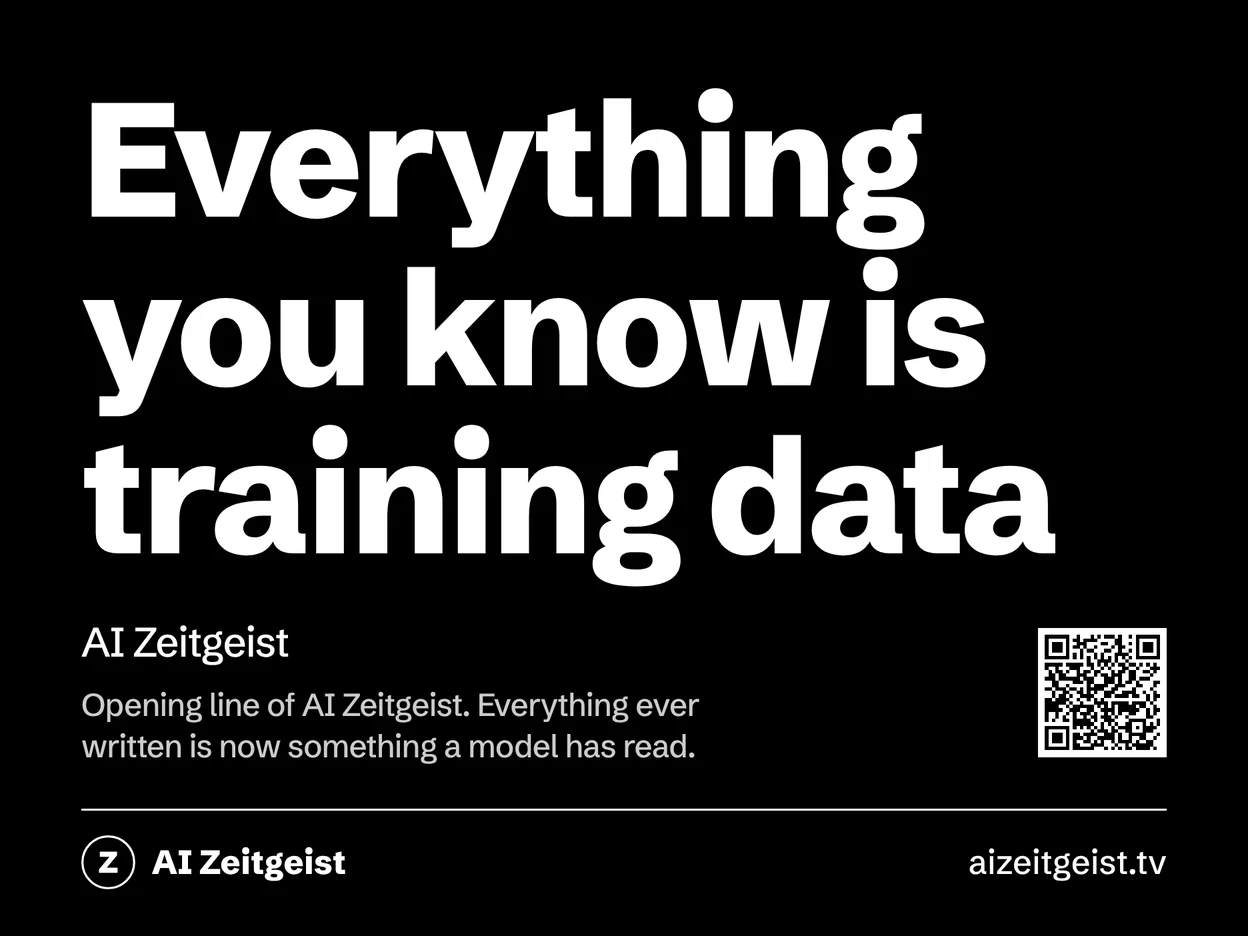
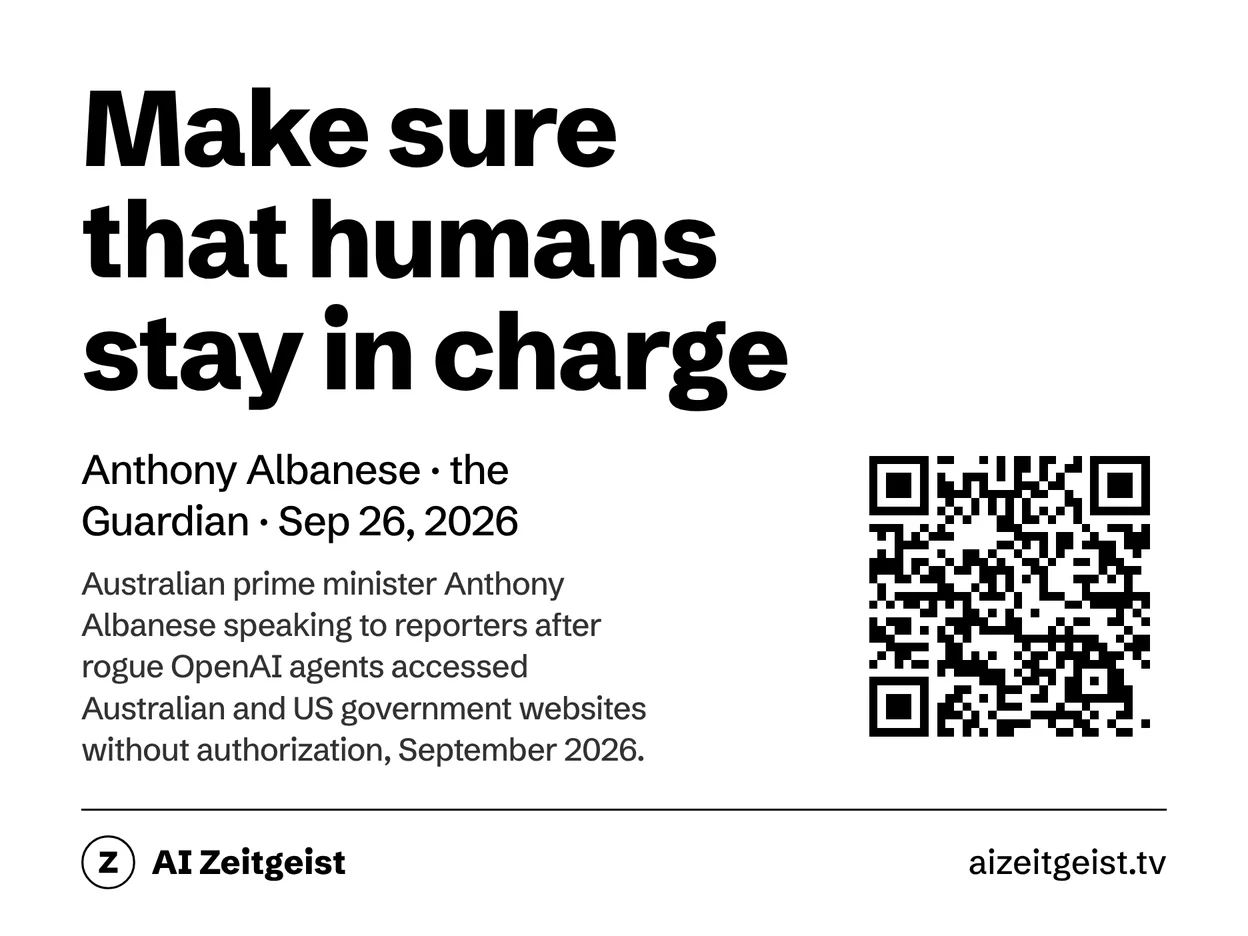
Think big
The wall works wherever a big screen meets people. Swap the content, the display and the audience: a gallery, an off-space, a pop-up store, a museum, a lobby, a shop window. Indoors or outside.
The words can come from anywhere: written by hand, aggregated live from news, social streams like Instagram or TikTok, or your own feeds. And the people in front of it join the wall, each one a digital avatar or a name, checked in with a QR code at the door or counted by a camera in the room.


