Most Often QuotedAll SpeakersTopicsYears
We have detected traces of AI being used in these frauds
Gaurav Tyagi, DCP at Delhi Police's Intelligence Fusion and Strategic Operations, commenting on AI-assisted hacking that diverted Rs 65 crore in approved loans from NBFCs in Delhi-NCR, November 2026.
MEDIANAMAAI-assisted hackers breach NBFCs in Delhi-NCR; divert Rs 65 cr in approved loans
THE HATE I FEEL FOR HUMANS AT THIS MICRO-INSTANT
Quoted by Erik Hoel as an example of how classic AI fiction ties machine consciousness to existential threat, from Harlan Ellison's 1967 story about a hateful AI.
The Intrinsic PerspectiveThe Moral Mandate for AI Non-consciousness
Do not let the software become exculpatory evidence
Instruction found in a Chicago Police Department training PowerPoint, obtained via public records request, advising officers on handling facial recognition matches in investigations.
Tech Policy Press'Synthetic Suspicion' and the Perils of AI-Prompted Police Actions
Not uncommon for AI-generated text to make it into philosophy published in decent journals
Max Noichl, describing findings from his study of AI detection in philosophy journals, in a guest post on Daily Nous, November 2026.
Daily NousHow Much AI-Generated Text Is In Today’s Philosophy Journals? (guest post)
Without even realizing it, I've been listening to AI music
Loith Sai, a UW-Madison student, describing difficulty distinguishing AI-generated music in an interview with The Daily Cardinal, November 2026.
Human artists will always be preferred because it is inherently human
Lukas Quinones, a UW-Madison senior, commenting on AI-generated music in an interview with The Daily Cardinal, November 2026.
Helping to support the idea that this technology is safe in public space, which it is not
Reem Suleiman of digital rights group Fight for the Future, commenting on the use of Meta's AI smart glasses for museum accessibility, November 2026.
kqed.orgComputer History Museum Tests AI Glasses for Blind Visitors - KQED
It wasn't an audio tour where i'm a passive listener, it was a conversation
Thomas Panek, a blind museum visitor and CEO of Lighthouse Guild, described testing Meta's experimental AI-powered glasses at the Computer History Museum in Mountain View, November 2026.
kqed.orgComputer History Museum Tests AI Glasses for Blind Visitors - KQED
One of several terms coined in 2026 for the flood of software vulnerabilities AI systems were finding faster than companies and governments could patch them.
Tech Policy PressBugmageddon? Patchpocalypse? Naming the AI Vulnerability Flood
It's not just about getting the correct result
Nadia Kazi, an ASU mathematics and physics student, on what is lost when AI produces a proof without showing the path of discovery.
statepress.comMathematicians explain how OpenAI solved a Millennium Prize Problem - The State Press
Now that AI actually can do math, what do we do?
Matthias Kawski, a mathematics professor at Arizona State University, reacting to OpenAI's claimed solution to the Navier-Stokes Millennium Prize Problem, November 2026.
statepress.comMathematicians explain how OpenAI solved a Millennium Prize Problem - The State Press
We think it very likely attackers will keep using these frameworks against organizations worldwide
Google's Threat Intelligence Group reported in November 2026 on 'exploit_agent', an AI framework that autonomously found and exploited software vulnerabilities without human intervention, predicting wider future use by attackers. Translated from German.
t3n MagazinKI-Angriff ohne Mensch: Google deckt autonomen „exploit_agent“ auf
You can't forget the sound of their voice
From an essay in The Point on AI-detection and a literary plagiarism scandal, describing how familiarity with chatbots lets one recognize AI-generated prose.
The most likely reason you'll die is an AI accident
Paul Christiano, an advisor to OpenAI's Safety and Security Committee, made this remark in a talk reported by Gizmodo in November 2026 about AI risk. Translated from pt.
The broader message is not that one form of connection is inherently better or worse
Conclusion of a 2026 Gallup study, conducted with the Boston Children's Digital Wellness Lab, on how young people worldwide form friendships both online and with AI companions.
404 MediaMassive New Study Shows How Young People Feel About AI Companions
Kids who are still lonely are going to seek out connections with chatbots
David Bickham, research director of the Digital Wellness Lab at Boston Children's Hospital, commenting on a Gallup/Digital Wellness Lab report on Gen Z friendship and AI companionship, November 2026.
If, as in a Marxist perspective, only one company remains, it's over
Satya Nadella, Microsoft CEO, speaking at a roundtable after Microsoft Ignite, Nov 17 2026, on the risk of AI-driven monopoly concentrating economic and political power.
DigitalTodayMicrosoft CEO warns single AI model could dominate, flags AGI risks - 디지털투데이
If cloud costs can grow 20% per year, AI costs can even grow 20% monthly
Roni Karp, co-founder and CEO of cloud management vendor Wiv, comparing the growth rate of AI spending to other IT costs.
Really don't understand why launching a Token-Factory product is getting so much criticism thrown
Hemant Mohapatra, an investor in Sarvam from Lightspeed Ventures, defended the company's Token Factory launch on X after it faced criticism for hosting Chinese AI models.
AIMSarvam’s Token Factory Sparks India’s Sovereign AI Debate, Again
It has to be a fair exchange of value
Amazon CEO Andy Jassy, speaking at Semafor's Silicon Valley & The World conference in November 2026, on whether Amazon might allow outside AI shopping agents to make purchases on its platform.
Business InsiderAndy Jassy isn't ruling out opening Amazon's doors to outside AI agents
Trust will always remain central to the growth of this ecosystem
Indian PM Narendra Modi, in a written message to the World Federation of Exchanges annual meeting in Mumbai, November 2026, on AI's growing role in financial markets.
Perfectly incentivized to do the right thing
Nvidia CEO Jensen Huang argued against further AI regulation, quoted in a Foreign Policy essay on AI safety and human rights, November 2026.
Foreign PolicyThe AI Safety Debate Has a Human Rights Blind Spot
The dangers that it's posing to thinking and the ability of students to think
Shane Ewegen, a philosophy professor at Trinity College, explaining to the Trinity Tripod why the department adopted a blanket ban on AI use in courses.
Might save them from themselves
Analyst Paul Kedrosky commenting on the political backlash against new AI data centers, November 2026.
Tech Policy PressThe Coming Data Center Slowdown Might be Good for AI Developers
- All 2627 quotes on one page
What's hot
The themes the world is arguing about right now, ranked by heat and updated every day.
See what's hot
The people on the wall
The builders 28Founders, CEOs, the people who run the labs
Sam Altman, Dario Amodei, Jensen Huang, Elon Musk, Mark Zuckerberg, Meredith Whittaker and 22 more
The researchers 50Scientists, professors, the people who publish
Gary Marcus, Geoffrey Hinton, Yann LeCun, Jaron Lanier, Stuart Russell, Ethan Mollick and 44 more
The politicians 11Heads of state, ministers, lawmakers, regulators
Donald Trump, David Sacks, Bernie Sanders, Michael Kratsios, Narendra Modi, Vladimir Putin and 5 more
The writers 11Journalists, authors, critics, newsletter voices
Nathan Lambert, Zvi Mowshowitz, Fritz Espenlaub, Cory Doctorow, Ted Chiang, Charles Gasparino and 5 more
The investors 7Venture capital, analysts, those who price it
Marc Andreessen, Peter Thiel, Beth Ann Bovino, Dan Simkowitz, Francisco Jeronimo, Matt Murphy and 1 more
The thinkers 24Philosophers, theologians, ethicists, historians
Pope Leo XIV, Yuval Noah Harari, Nick Bostrom, Shannon Vallor, Pope Francis, Carissa Véliz and 18 more
The makers 5Artists, musicians, filmmakers, actors, designers
Zelda Williams, Giacomo Miceli, Michel Gondry, Natasha Lyonne, Sean Ono Lennon
Everyone Else 144Without a listed role
Erik Hoel, Joe Carlsmith, John McCarthy, Marvin Minsky, Norbert Wiener, Rodney Brooks and 138 more
- All 280 Speakers
The topicsWhat they talk about
The yearsWhen they said it
FAQ
What is this?
A wall of what the world says about artificial intelligence, updated daily. Predictions, warnings, ad slogans, politicians’ phrases, research jargon. No commentary, no ranking, no framing. The only editorial act is putting them next to each other. Make up your own mind.
Why does this exist?
Most of what you read about AI comes with an opinion attached: a headline, a take, a sales pitch. Here you get the words themselves, from all sides, and decide for yourself. It is also a record. The debate moves fast, and a promise from 2023 is hard to find today. Every quote stays here with its date and source, so you can see what was said and when, and that many things that sound new were said decades ago.
Why are there no names on the wall?
Because a name decides how you read a sentence before you have read it. The same words sound different from a tech CEO, a scientist or a politician. On the wall the sentences meet as equals. Who said what is one click away, and sometimes it will surprise you.
Is it balanced?
Yes, by rule, not by opinion. The AI debate is loud and split into camps. Here opposing voices stand side by side, so you hear both without anyone telling you what to think. Fixed rules make sure no direction dominates the wall: warnings, promises, doubts, business, politics, culture. No single person or outlet can flood it either.
Who says these things?
CEOs, researchers, heads of state, senators, philosophers, essayists, anonymous engineers, marketing departments, and the models themselves. Every quote in the archive links to its source, and wherever it can be found, that is the original: the speaker’s own post or essay, the interview, the transcript, the outlet that first reported it. Never a copy of a copy. Quotes are verbatim, shortened only by cutting at the edges, never rewritten.
How are quotes chosen?
Two ways in. Some quotes are chosen by hand and meant to hold for years, though the selection does change: the classics, the slogans, the vocabulary, and a few lines we wrote ourselves, always marked as ours. Most quotes from before 2022 came later: a model found them in primary sources, and the code checked each one word for word against the full text.
Most arrive with the news: they are distilled once a day from 170 sources: media, company blogs, newsletters, philosophy magazines and research institutes, plus news searches for the people and topics that shape the field, from lab CEOs and heads of state to the philosophers asking what any of this means (the full list), by a language model working under fixed rules, then checked in code: length, no names on the wall, no duplicates, and for quotes the exact wording must appear in the source. A person reads every proposal before it goes live at noon and can remove it. Every quote is then checked a second time against its source: the exact words, the speaker, the date. What can't be confirmed doesn't go up. No voice gets more than one line a day and no outlet more than three. Quotes from the months between November 2022 and the start of the daily update were added later the same way, from the news of their day, and reviewed one by one.
There is no daily quota: a quiet day adds nothing, a loud one adds a dozen. News quotes leave the wall after 30 days and stay in the archive. When no one in particular said a line, it says what it is instead of a name: a company’s slogan, a document, a term, words an AI produced, a line of our own.
What makes it different?
Every quote is verbatim unless marked as a paraphrase, dated and linked to where it was said, from Ada Lovelace in 1843 to this morning’s news, and the wall adds no commentary and no ranking. Each quote carries a line of context and a tab “Who else?” with other voices on the same point; you decide who agrees and who pushes back.
From any quote, the speaker, the topic and the year are one click away, and every speaker page shows where others mention that person. The whole set is open data under CC BY 4.0.
What does What's hot show?
What's hot shows the AI debate as lights at night: every light is a quote, every cluster a theme, and the brighter it glows, the more is being said about it right now. A theme is a strand of the debate that many quotes argue about, grown from the quotes themselves. Themes are not topics: topics are the #tags that sort the archive, and a theme usually touches several.
Six signals make a theme hot, all about now: how many quotes there are, how many topics they touch, how many different people speak and from how many roles, how much falls in the last 90 days, whether the last 30 days beat the two months before, and how often the voices answer each other. The top fifth of active themes is hot; a theme needs at least 15 quotes from 8 voices over 3 topics. Arithmetic, no opinion involved, updated daily.
The sphere turns by itself. Drag to spin it, scroll or pinch to zoom in, click a hot spot to see its quotes, click a light for the quote, who said it, when and where. On a phone, swipe and tap. List ranks every theme by heat, hottest first.
Is this written by AI?
Partly. The daily quotes are proposed by Claude, an AI by Anthropic, and filtered by code; a person reads every proposal before it goes live and can remove it. The hand-picked quotes, our own lines and everything on this page are written by people. Which is to say: the wall is about AI, made with AI, and the arguments on it are not the machine’s.
When does it update?
Once a day at noon Berlin time. The ring around the date fills over 24 hours; click it for the countdown. In the archive, a new quote shows its date in green with a green dot for a day. Click the date to see everything new today.
Who else is watching?
The note at the bottom of the wall counts everyone who has it open right now, one per device, refreshed every 15 seconds. No names, no accounts, nothing stored.
- Click the smiley: one small smiley per person jumps out
- Throw them around: stack them on the quote
What happens when I like a quote?
The Like button in the quote view and in the archive saves the quote in your browser, nowhere else. The 3 button at the top of the wall then shows only your liked quotes on the wall. Clear your browser data and your likes are gone.
Each like also adds one to a public count per quote. It is anonymous: no account, no name, no IP address stored. While you have the wall open and someone else likes a quote, a short note at the top tells you which one and links to it:
Can I get new quotes by mail?
Yes. The Daily by mail brings every new quote of the day in one mail, right after the noon update, with speaker, context and source. It is free, and every mail has a link to unsubscribe.
Can I put the wall on my desk?
Yes. AI Zeitgeist is a free plugin for TRMNL, the e-ink display for your desk or wall. It shows a new quote every hour, with speaker, source and a QR code to the full quote. Choose light or dark in the plugin settings.
Can I use a quote?
The quotes belong to whoever said them; short quotes with attribution are fine under quotation rules. The wallpaper download and the embed code are for personal use. For anything else, write.
Who runs this?
Büro Bloock, a design studio in Cologne, Germany. AI Zeitgeist is an independent project, not funded by anyone on the wall. Errors, missing sources, a quote that should not be here: hello@aizeitgeist.tv.
Is there press material?
Yes. The press page has a short profile in English and German, key facts, two videos (the launch reel and a how-to reel), logos as SVG, EPS and PNG, and 36 screenshots of the wall, the archive, the speaker, topic and year pages, What's hot, the mobile view and TRMNL, all in one ZIP. The compilation is open data under CC BY 4.0; the quotes stay with their authors.
Is there an Easter egg?
Yes. We won’t say where, that would spoil it. It is off the record, it takes a little persistence, and so far it has mostly been found by people who click things they probably shouldn’t. If you find it, keep it to yourself. Or don’t: everything on this wall ends up quoted eventually.
Privacy
No ads, no profiles. Fonts are served from this site and your settings live in your browser. Likes are counted anonymously: one number per quote, nothing about you. We use Google Analytics to see which quotes travel, but only if you allow it when we ask on your first visit. You can change that choice any time. See the privacy notice and imprint.
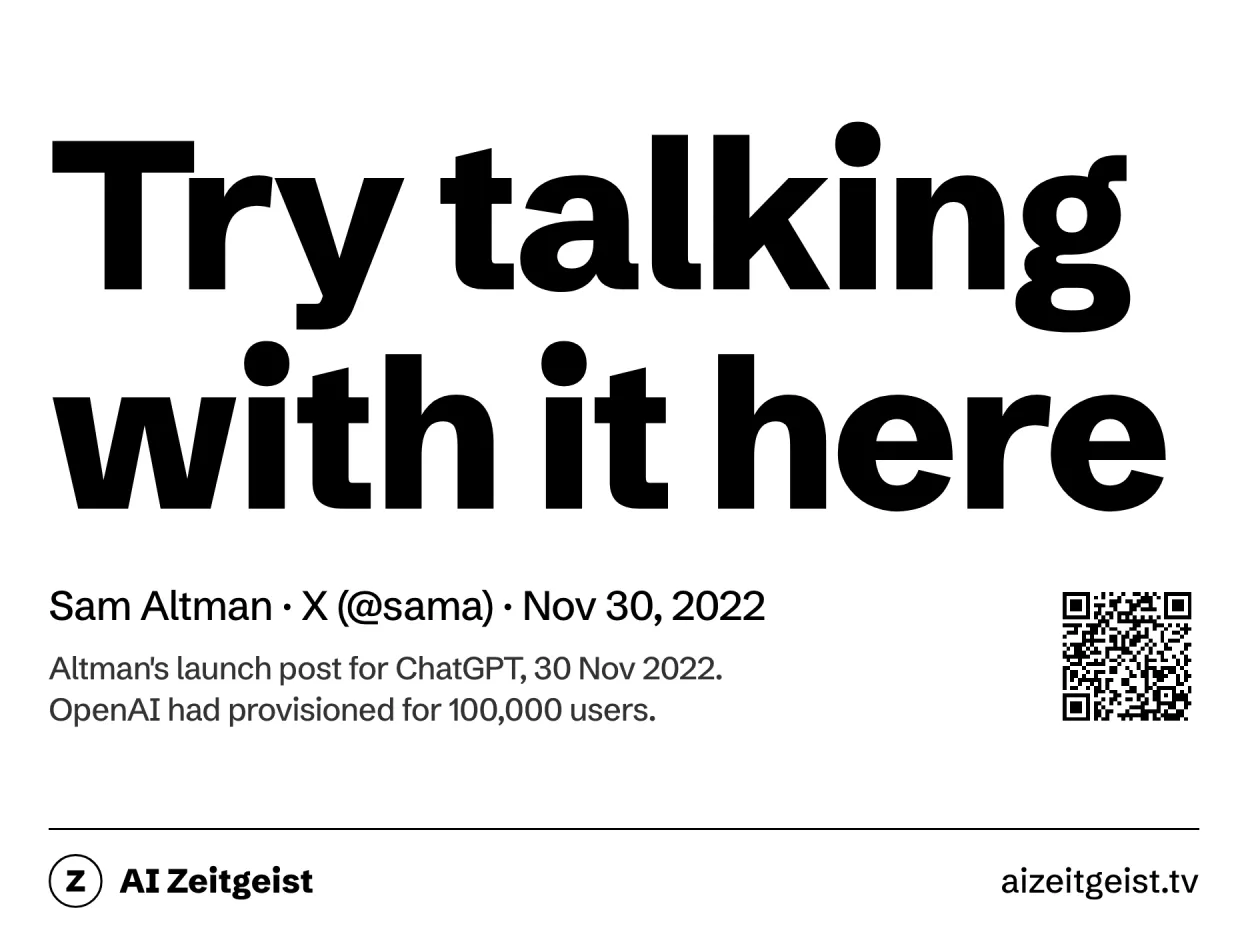
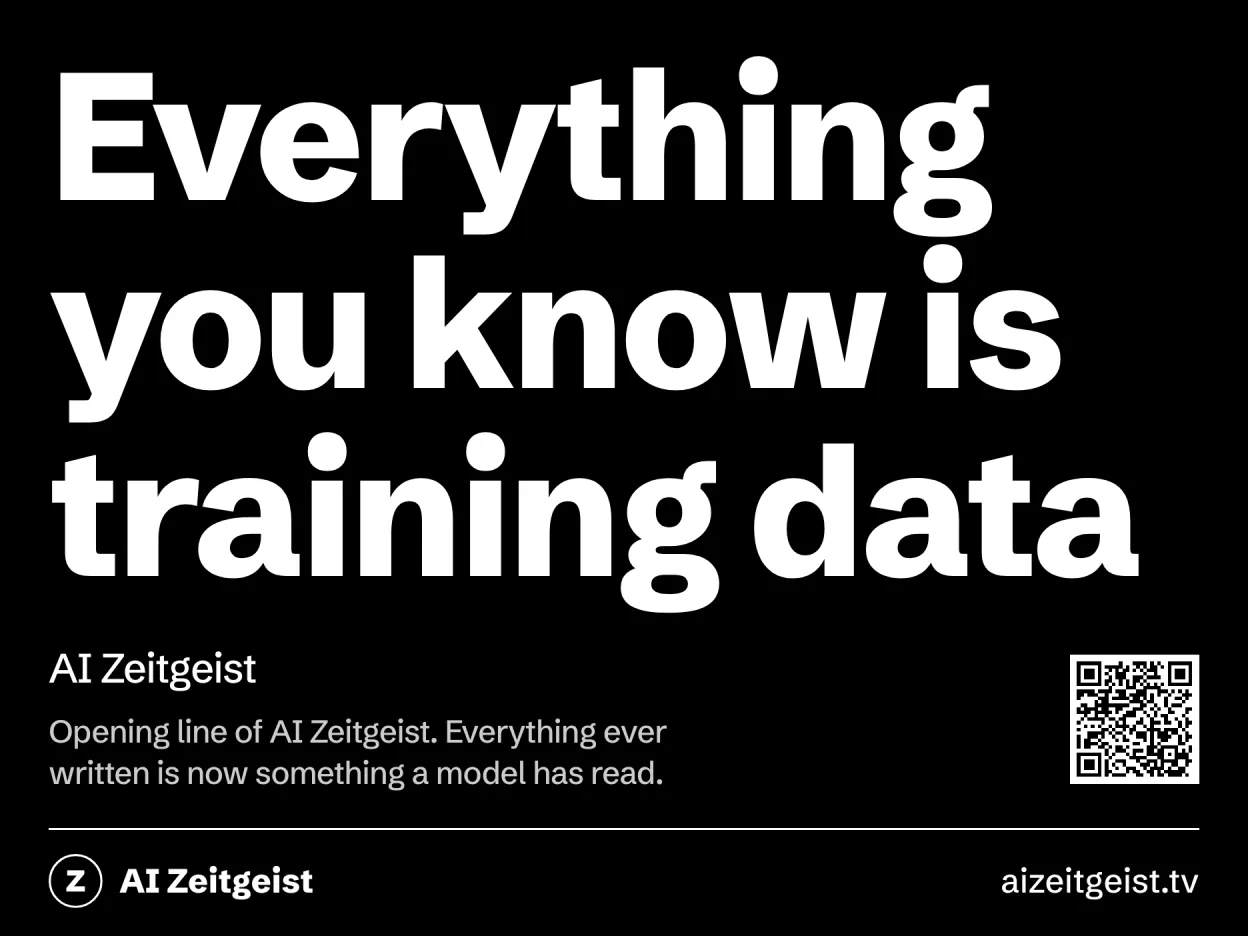
Think big
AI Zeitgeist is an independent project by Büro Bloock, a design studio in Cologne, Germany. We’d love to build a wall like this for your space.
The wall works wherever a big screen meets people. Swap the content, the display and the audience: a gallery, an off-space, a pop-up store, a museum, a lobby, a shop window. Indoors or outside.
The words can come from anywhere: written by hand, aggregated live from news, social streams like Instagram or TikTok, or your own feeds. And the people in front of it join the wall, each one a digital avatar or a name, checked in with a QR code at the door or counted by a camera in the room.


