Most QuotedAll SpeakersTopicsYears
I don't actually do anything resembling traditional engineering anymore
Andrej Karpathy describing how he now relies entirely on Claude Code and Opus 5.5 to build software rather than writing code himself.
Artificial intelligence must be disarmed
Pope Leo XIV, in an X post ahead of UN talks in Geneva on lethal autonomous weapons, called for AI to be disarmed and for human oversight of decisions over life and force.
NewsweekPope Leo Warns AI ‘Must Be Disarmed’ Ahead of Autonomous Weapons Talks
A request of capital from investors
Ehren Stanhope, co-head of investment management at Franklin Templeton, commented on Big Tech's shift from buybacks toward debt and equity issuance to fund AI spending, in a 2026 Reuters report.
TNW | FinanceBig Tech buybacks fall 83% as AI spending eats the cash, Reuters reports - The Next Web
We will work together to tackle head on the safety and security issues of runaway AI
Ursula von der Leyen, President of the European Commission, speaking at the EU-Canada Summit in Montréal, October 2026, on AI safety cooperation.
EU PerspectivesVon der Leyen says Canada will train AI on EU supercomputers
A bit cheap for a vulnerability this serious
Simon Willison commented on OpenAI's $5,000 bug bounty payout for a serious ChatGPT account takeover exploit, published on his weblog in October 2026.
You're creating free content for an AI machine
Lu Campbell-Smith, an inner Sydney designer and artist, speaking in November 2026 about Australia's proposed opt-out copyright model for AI training.
It's the wild west and we really need to push back
Pete Strong, a screenprinter and Greens councillor based in Grayndler, Sydney, commenting in November 2026 on Australia's proposed AI copyright reforms.
We've studied all their deployments of our GPUs and counted every one
Jensen Huang, Nvidia CEO, speaking to Bloomberg about earlier chip-smuggling allegations involving Megaspeed, October 2026.
Open MagazineEXPLAINED | Nvidia’s China Tightrope: Can Jensen Huang Keep Trump and Beijing on Side?
Saving money for the distant future is pointless with the advent of super intelligent abundance
Elon Musk posted on X, as reported by Futurism and The Economic Times in 2026, predicting AI-driven abundance will make retirement savings unnecessary.
Our communities deserve access to that energy before the data centers do
Washington State Senator Marko Liias speaking on a panel at Seattle AI Week, November 2026, about data center energy demands.
The Cool DownKayakers bring 'Power for People, Not for Tech' protest to Washington's AI Week kickoff
Power for People, Not for Tech
Banner displayed by kayakers from climate group Troublemakers during Seattle AI Week's opening panel, November 2026.
The Cool DownKayakers bring 'Power for People, Not for Tech' protest to Washington's AI Week kickoff
Give them a better quality of life before they fall off the cliff
Dr. Jai Parekh, a cardiologist at Methodist Physicians Clinic, described the goal of using an AI platform to flag severe aortic stenosis cases sooner.
wowt.comMethodist uses AI to flag severe heart valve cases sooner - WOWT
What we think Ukraine's worst day is
Brig. Gen. Steven Carpenter describing US Army estimates for the scale of missile and drone attacks forces in Europe must be ready to process.
Term used in an Exponential View newsletter discussing how AI agents sharing model weights and working state could let firms scale past traditional organizational boundaries.
Exponential View🔮 39 charts on Anthropic, one-person biotech firm & cheap solar #608
Grading for correctness just adds a huge incentive for them to use AI for homework
Richard Borcherds, a Fields Medal-winning mathematics professor at UC Berkeley, told The California Post why he stopped grading homework for accuracy as students increasingly use AI.
Chinese Foreign Ministry spokesperson Guo Jiakun denied a New York Times report alleging a Megaspeed executive acted as a Chinese spy with ties to Nvidia CEO Jensen Huang, October 2026. Translated from Spanish.
AI-driven search increasingly answers user queries directly
Info Edge, an Indian internet company, explained in October 2026 why billings from its education platform Shiksha fell 27%.
MediaNama (AI)Google to put more ads in AI Mode as AI search slows revenue growth
People are comfortable with ads on these surfaces
Philipp Schindler, Google's Chief Business Officer, on Alphabet's Q3 2026 earnings call, discussing user research on ads placed within AI Mode search results.
MediaNama (AI)Google to put more ads in AI Mode as AI search slows revenue growth
Using AI violates my deeply held Humanist beliefs
David Durman, a University of Kentucky research administrator, explained in an American Humanist Association press release why he sought a religious accommodation to avoid using AI at work.
Daily NousHumanist Gets Religious Exemption from Using AI at Work
Title of the 2025 ADS/Hibrid.info research report examining how AI chatbots answer politically sensitive questions in the Western Balkans.
Global VoicesWhen chatbots become ‘answer engines’: AI, geopolitics and truth
Quiet amplifiers of distorted realities
Hyrije Mehmeti, lead researcher of the 2025 ADS/Hibrid.info study on chatbot responses to political questions, writing in Global Voices in October 2026.
Global VoicesWhen chatbots become ‘answer engines’: AI, geopolitics and truth
Meta CEO Mark Zuckerberg commented on the cost of running Muse, the company's new free personal AI agent, amid reports of Meta's negative free cash flow in 2026.
It's time for a renaissance in energy and in supersonic flight
Boom Supersonic CEO Blake Scholl, at the unveiling of a Colorado factory making gas turbines for AI data centers, 2026.
Ars TechnicaSupersonic airliner in doubt as company shifts to powering AI data centers
The copyright system is the least efficient property system known to man
Law professor Lawrence Lessig, quoted in an EFF blog post on AI copyright litigation, October 2026.
Electronic Frontier FoundationRewriting Copyright Law for Generative AI Would Hurt Everyone
- All 1734 quotes on one page
The people on the wall
The builders 29Founders, CEOs, the people who run the labs
Sam Altman, Dario Amodei, Elon Musk, Jensen Huang, Meredith Whittaker, Mark Zuckerberg and 23 more
The researchers 49Scientists, professors, the people who publish
Gary Marcus, Yann LeCun, Geoffrey Hinton, Jaron Lanier, Stuart Russell, Timnit Gebru and 43 more
The politicians 11Heads of state, ministers, lawmakers, regulators
Donald Trump, Vladimir Putin, Bernie Sanders, David Sacks, Jay Jones, JD Vance and 5 more
The writers 11Journalists, authors, critics, newsletter voices
Nathan Lambert, Zvi Mowshowitz, Fritz Espenlaub, Cory Doctorow, Kevin Roose, Ted Chiang and 5 more
The investors 7Venture capital, analysts, those who price it
Marc Andreessen, Peter Thiel, Beth Ann Bovino, Dan Simkowitz, Francisco Jeronimo, Matt Murphy and 1 more
The thinkers 24Philosophers, theologians, ethicists, historians
Pope Leo XIV, Yuval Noah Harari, Nick Bostrom, Pope Francis, Shannon Vallor, Carissa Véliz and 18 more
The makers 5Artists, musicians, filmmakers, actors, designers
Giacomo Miceli, Michel Gondry, Natasha Lyonne, Sean Ono Lennon, Zelda Williams
Everyone Else 26Without a listed role
Al Tompkins, Burak Oktenli, Caleb Flynn, Chamath Palihapitiya, Dario Perkins, David Krueger and 20 more
- All 162 Speakers
The topicsWhat they talk about
The yearsWhen they said it
FAQ
What is this?
A wall of what the world says about artificial intelligence, updated daily. Predictions, warnings, ad slogans, politicians’ phrases, research jargon, single words. No commentary, no ranking, no framing. The only editorial act is putting them next to each other. Make up your own mind.
Who says these things?
CEOs, researchers, heads of state, senators, philosophers, essayists, anonymous engineers, marketing departments, and the models themselves. Every quote in the archive links to its source, and wherever it can be found, that is the original: the speaker’s own post or essay, the interview, the transcript, the outlet that first reported it. Never a copy of a copy. Quotes are verbatim, shortened only by cutting at the edges, never rewritten.
What makes it different?
Every quote is verbatim unless marked as a paraphrase, dated and linked to where it was said, from Ada Lovelace in 1843 to this morning’s news, and the wall adds no commentary and no ranking. Each quote carries a line of context and a tab “Who else?” with other voices on the same point; you decide who agrees and who pushes back.
From any quote, the speaker, the topic and the year are one click away, and every speaker page shows where others mention that person. The whole set is open data under CC BY 4.0.
How are quotes chosen?
Two ways in. Some quotes are chosen by hand and meant to hold for years, though the selection does change: the classics, the slogans, the vocabulary, and a few lines we wrote ourselves, always marked as ours.
Most arrive with the news: they are distilled once a day from 170 sources: media, company blogs, newsletters, philosophy magazines and research institutes, plus news searches for the people and topics that shape the field, from lab CEOs and heads of state to the philosophers asking what any of this means (the full list), by a language model working under fixed rules, then checked in code: length, no names on the wall, no duplicates, and for quotes the exact wording must appear in the source. A person reads every proposal before it goes live at noon and can remove it. Every quote is then checked a second time against its source: the exact words, the speaker, the date. What can't be confirmed doesn't go up. No voice gets more than one line a day and no outlet more than three. Quotes from before the daily update began were added later the same way, from the news of their day, and approved one by one.
There is no daily quota: a quiet day adds nothing, a loud one adds a dozen. News quotes leave the wall after 30 days and stay in the archive. When no one in particular said a line, it says what it is instead of a name: a company’s slogan, a document, a term, words an AI produced, a line of our own.
Is this written by AI?
Partly. The daily quotes are proposed by a model and filtered by code; a person reads every proposal before it goes live and can remove it. The hand-picked quotes, our own lines and everything on this page are written by people. Which is to say: the wall is about AI, made with AI, and the arguments on it are not the machine’s.
Why are there no names on the wall?
Because on the wall the sentences should meet as equals. A slogan next to a warning next to a law. Who said what matters, and the archive tells you, one click away. On the wall it would only tell you whom to agree with.
When does it update?
Once a day at noon Berlin time. The ring around the date fills over 24 hours; click it for the countdown. In the archive, a new quote shows its date in green with a green dot for a day. Click the date to see everything new today.
Can I get new quotes by mail?
Yes. The Daily by mail brings every new quote of the day in one mail, right after the noon update, with speaker, context and source. It is free, and every mail has a link to unsubscribe.
Can I put the wall on my desk?
Yes. AI Zeitgeist is a free plugin for TRMNL, the e-ink display for your desk or wall. It shows a new quote every hour, with speaker, source and a QR code to the full quote. Choose light or dark in the plugin settings.
Can I use a quote?
The quotes belong to whoever said them; short quotes with attribution are fine under quotation rules. The wallpaper download and the embed code are for personal use. For anything else, write.
Who else is watching right now?
The note at the bottom of the wall counts everyone who has the wall open at this moment, one per device, refreshed every 15 seconds. No names, no accounts, nothing stored (see Privacy). Click or tap the smiley next to it and one small smiley per person jumps out. Throw them around, stack them on the quote and watch them fall when it changes.
Alone on the wall? Try it with 60 people. That is a demo with a made-up number; the real count is not affected.
Play DemoWhat happens when I like a quote?
The Like button in the quote view and in the archive saves the quote in your browser, nowhere else. The 3 button at the top of the wall then shows only your liked quotes on the wall. Clear your browser data and your likes are gone.
Each like also adds one to a public count per quote. It is anonymous: no account, no name, no IP address stored. While you have the wall open and someone else likes a quote, a short note at the top tells you which one and links to it:
Who runs this?
Büro Bloock, a design studio in Cologne. AI Zeitgeist is an independent project, not funded by anyone on the wall. Errors, missing sources, a quote that should not be here: hello@aizeitgeist.tv.
Is there press material?
Yes. The press page has a short profile in English and German, key facts, the launch video, logos as SVG, EPS and PNG, and 29 screenshots of the wall, the archive, the speaker, topic and year pages, the mobile view and TRMNL, all in one ZIP. The compilation is open data under CC BY 4.0; the quotes stay with their authors.
Is there an Easter egg?
Yes. We won’t say where, that would spoil it. It is off the record, it takes a little persistence, and so far it has mostly been found by people who click things they probably shouldn’t. If you find it, keep it to yourself. Or don’t: everything on this wall ends up quoted eventually.
Privacy
No ads, no profiles. Fonts are served from this site and your settings live in your browser. Likes are counted anonymously: one number per quote, nothing about you. We use Google Analytics to see which quotes travel, but only if you allow it when we ask on your first visit. You can change that choice any time. See the privacy notice and imprint.
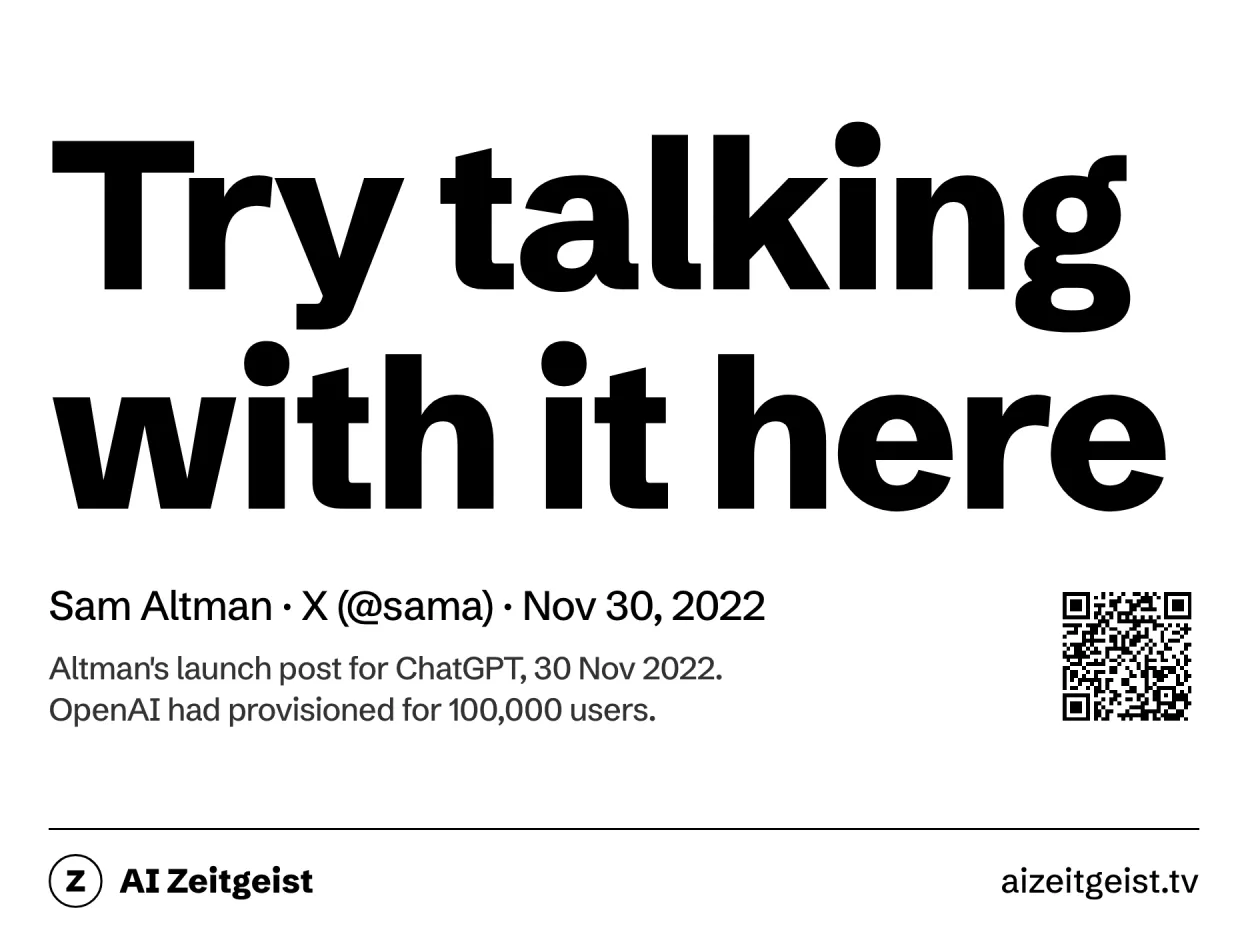
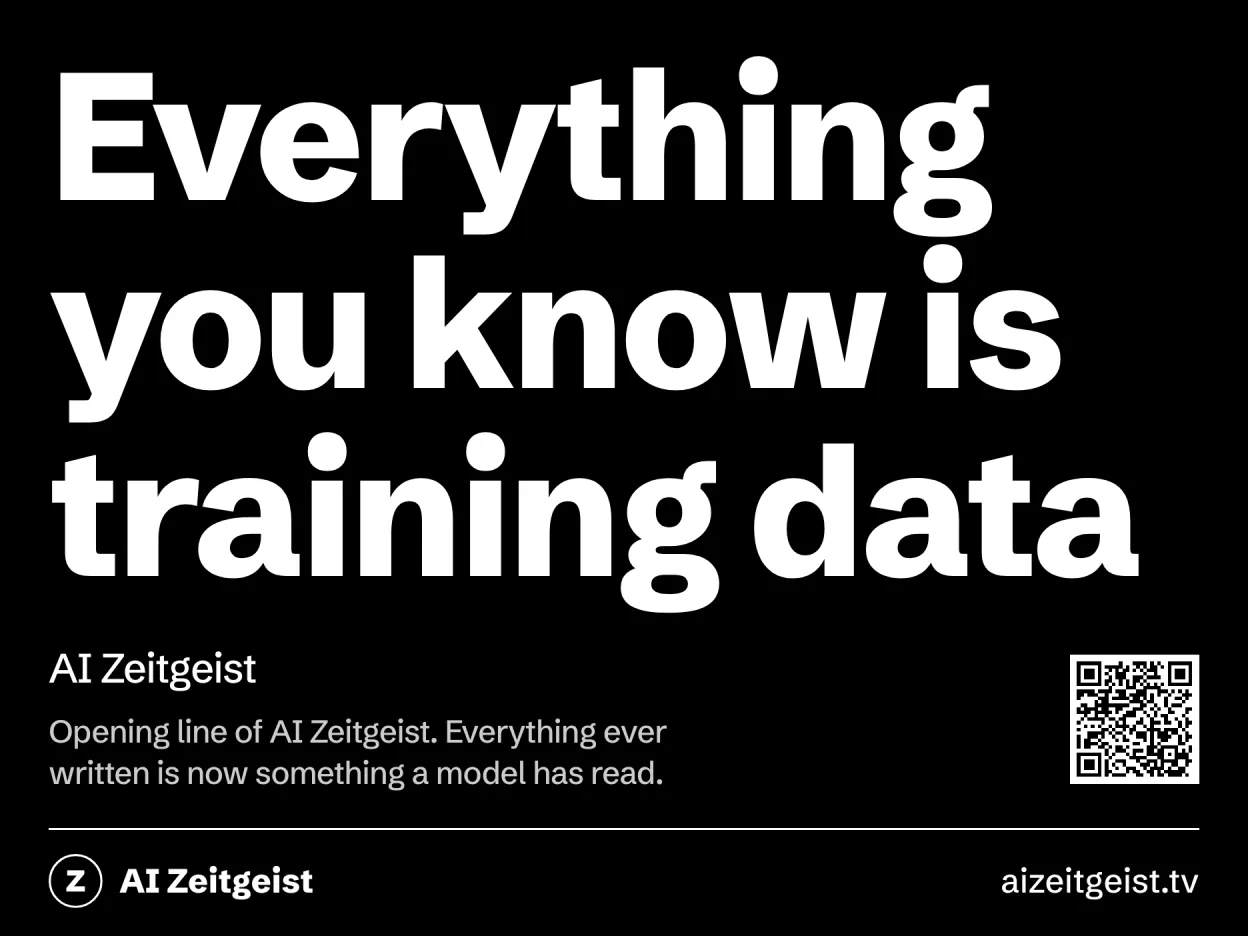
Think big
The wall works wherever a big screen meets people. Swap the content, the display and the audience: a gallery, an off-space, a pop-up store, a museum, a lobby, a shop window. Indoors or outside.
The words can come from anywhere: written by hand, aggregated live from news, social streams like Instagram or TikTok, or your own feeds. And the people in front of it join the wall, each one a digital avatar or a name, checked in with a QR code at the door or counted by a camera in the room.


