Most Often QuotedAll SpeakersTopicsYears
AI data centers are destroying our climate, they are poisoning our water
An audience member shouted this during a Maine Senate debate featuring Sen. Susan Collins, amid rising local opposition to AI data center expansion, October 2026.
Hire the robot, fire the human and don't look back
Bill Gates, in an interview with The Observer in 2026, criticized the business incentive to automate jobs with AI.
Trust is a form of social capital that cannot be automated
From a Korean opinion column on civilization in the age of AI and AGI, arguing that human trust remains irreplaceable as machines take over cognitive tasks.
서울시티The Shift in Human Civilization in the Era of AI, AGI, and ASI (3) - 의정신문 서울시티
Developing conscious AIs would be reckless, and we should not build them
Microsoft AI CEO Mustafa Suleyman, in an X post published November 2026, argued against building conscious AI systems.
Los Angeles TimesMicrosoft AI CEO warns industry against trying to build conscious machines
I don't really consider it art because it's not something that you personally made
Claire Drayer, a graphic design student at Ohio University, on why she does not consider AI-generated work art, November 2026.
It had a bunch of AI garbage on it
Sam Boyde, a studio art student at Ohio University in Athens, criticized AI-generated artwork used by local food trucks, November 2026.
The axis of AI improvement here is not speed or scale but effort displacement
Cisco Talos's analysis of the VOLTA infostealer, which uses an LLM to automate the analytical work of ranking stolen victim data by monetization value.
VOLTA builds a structured evidence bundle about the person behind the machine
Cisco Talos researcher Ryan Fetterman describing the VOLTA-AUTODOXER infostealer, which uses LLMs to profile and rank victims by financial value, November 2026.
Everyone wants to protect their own data and unique advantage
Dinesh Agarwal, co-founder and CEO of IndiaMART, on an investor call in November 2026, explaining why the company is restricting its data from Google and AI agents.
MEDIANAMAIndiaMART moves content behind logins to defend its data moat against Search and AI agents
We retain only classifier scores, not prompts or outputs
From Anthropic's October 2026 SEC filing ahead of its IPO, describing Zero Data Retention terms under which it keeps no record of customer conversations.
Historian Yuval Noah Harari, speaking on his YouTube channel in November 2026, compared AI systems like ChatGPT and Claude to bureaucrats thriving in artificial, rule-bound environments.
Phrase from Anthropic's values statement describing its mission, cited amid reports of its upcoming IPO and concerns over staff wealth.
The agentic web is here earlier than people expect
Ethan Mollick, a professor at the Wharton School, commenting in MIT Technology Review on how quickly AI agents have become capable of navigating the web.
Shaping AI: safe, sovereign, competitive
Motto of the German government's two-day Digitalgipfel 2026 in Berlin, opened by digital minister Karsten Wildberger, focused on AI competitiveness and sovereignty in Europe.
deutschland.deBerliner Digitalgipfel: Wildberger will Europa bei KI stärken
One of the main tools for mathematic research going forward is under the control of two US companies
Martin Hairer, Fields medal winner, at a Royal Society meeting on AI's role in mathematics, November 2026.
The ObserverMathematicians warn AI firms are keeping vital research in the field secret
Knowledge could be hoarded behind paywalls
Martin Bridson, president of the Clay Mathematics Institute, speaking at a Royal Society meeting of mathematicians in London, November 2026, on AI firms controlling access to mathematical knowledge.
The ObserverMathematicians warn AI firms are keeping vital research in the field secret
Term used in reporting on hikers relying on AI chatbots for trail advice, describing users who stop questioning an AI system's answers.
The 420.inAI Chatbots Put Hikers At Risk As Experts Warn Against Blind Reliance
The opportunity isn't to replace the farmer's judgement
Christophe Bur, co-director of Regen Farmers Mutual, discussing AI adoption among Australian farmers, Dubbo Photo News, November 2026.
I don't actually do anything resembling traditional engineering anymore
Andrej Karpathy describing how he now relies entirely on Claude Code and Opus 5.5 to build software rather than writing code himself.
Artificial intelligence must be disarmed
Pope Leo XIV, in an X post ahead of UN talks in Geneva on lethal autonomous weapons, called for AI to be disarmed and for human oversight of decisions over life and force.
NewsweekPope Leo Warns AI ‘Must Be Disarmed’ Ahead of Autonomous Weapons Talks
A request of capital from investors
Ehren Stanhope, co-head of investment management at Franklin Templeton, commented on Big Tech's shift from buybacks toward debt and equity issuance to fund AI spending, in a 2026 Reuters report.
TNW | FinanceBig Tech buybacks fall 83% as AI spending eats the cash, Reuters reports - The Next Web
We will work together to tackle head on the safety and security issues of runaway AI
Ursula von der Leyen, President of the European Commission, speaking at the EU-Canada Summit in Montréal, October 2026, on AI safety cooperation.
EU PerspectivesVon der Leyen says Canada will train AI on EU supercomputers
A bit cheap for a vulnerability this serious
Simon Willison commented on OpenAI's $5,000 bug bounty payout for a serious ChatGPT account takeover exploit, published on his weblog in October 2026.
You're creating free content for an AI machine
Lu Campbell-Smith, an inner Sydney designer and artist, speaking in November 2026 about Australia's proposed opt-out copyright model for AI training.
- All 1752 quotes on one page
The people on the wall
The builders 29Founders, CEOs, the people who run the labs
Sam Altman, Dario Amodei, Elon Musk, Jensen Huang, Meredith Whittaker, Mark Zuckerberg and 23 more
The researchers 49Scientists, professors, the people who publish
Gary Marcus, Yann LeCun, Geoffrey Hinton, Jaron Lanier, Stuart Russell, Timnit Gebru and 43 more
The politicians 11Heads of state, ministers, lawmakers, regulators
Donald Trump, Vladimir Putin, Bernie Sanders, David Sacks, Jay Jones, JD Vance and 5 more
The writers 11Journalists, authors, critics, newsletter voices
Nathan Lambert, Zvi Mowshowitz, Fritz Espenlaub, Cory Doctorow, Kevin Roose, Ted Chiang and 5 more
The investors 7Venture capital, analysts, those who price it
Marc Andreessen, Peter Thiel, Beth Ann Bovino, Dan Simkowitz, Francisco Jeronimo, Matt Murphy and 1 more
The thinkers 24Philosophers, theologians, ethicists, historians
Pope Leo XIV, Yuval Noah Harari, Nick Bostrom, Pope Francis, Shannon Vallor, Carissa Véliz and 18 more
The makers 5Artists, musicians, filmmakers, actors, designers
Giacomo Miceli, Michel Gondry, Natasha Lyonne, Sean Ono Lennon, Zelda Williams
Everyone Else 26Without a listed role
Al Tompkins, Burak Oktenli, Caleb Flynn, Chamath Palihapitiya, Dario Perkins, David Krueger and 20 more
- All 162 Speakers
The topicsWhat they talk about
The yearsWhen they said it
FAQ
What is this?
A wall of what the world says about artificial intelligence, updated daily. Predictions, warnings, ad slogans, politicians’ phrases, research jargon. No commentary, no ranking, no framing. The only editorial act is putting them next to each other. Make up your own mind.
Why does this exist?
Most of what you read about AI comes with an opinion attached: a headline, a take, a sales pitch. Here you get the words themselves, from all sides, and decide for yourself. It is also a record. The debate moves fast, and a promise from 2023 is hard to find today. Every quote stays here with its date and source, so you can see what was said and when, and that many things that sound new were said decades ago.
Why are there no names on the wall?
Because a name decides how you read a sentence before you have read it. The same words sound different from a tech CEO, a scientist or a politician. On the wall the sentences meet as equals. Who said what is one click away, and sometimes it will surprise you.
Is it balanced?
Yes, by rule, not by opinion. The AI debate is loud and split into camps. Here opposing voices stand side by side, so you hear both without anyone telling you what to think. Fixed rules make sure no direction dominates the wall: warnings, promises, doubts, business, politics, culture. No single person or outlet can flood it either.
Who says these things?
CEOs, researchers, heads of state, senators, philosophers, essayists, anonymous engineers, marketing departments, and the models themselves. Every quote in the archive links to its source, and wherever it can be found, that is the original: the speaker’s own post or essay, the interview, the transcript, the outlet that first reported it. Never a copy of a copy. Quotes are verbatim, shortened only by cutting at the edges, never rewritten.
How are quotes chosen?
Two ways in. Some quotes are chosen by hand and meant to hold for years, though the selection does change: the classics, the slogans, the vocabulary, and a few lines we wrote ourselves, always marked as ours.
Most arrive with the news: they are distilled once a day from 170 sources: media, company blogs, newsletters, philosophy magazines and research institutes, plus news searches for the people and topics that shape the field, from lab CEOs and heads of state to the philosophers asking what any of this means (the full list), by a language model working under fixed rules, then checked in code: length, no names on the wall, no duplicates, and for quotes the exact wording must appear in the source. A person reads every proposal before it goes live at noon and can remove it. Every quote is then checked a second time against its source: the exact words, the speaker, the date. What can't be confirmed doesn't go up. No voice gets more than one line a day and no outlet more than three. Quotes from before the daily update began were added later the same way, from the news of their day, and approved one by one.
There is no daily quota: a quiet day adds nothing, a loud one adds a dozen. News quotes leave the wall after 30 days and stay in the archive. When no one in particular said a line, it says what it is instead of a name: a company’s slogan, a document, a term, words an AI produced, a line of our own.
What makes it different?
Every quote is verbatim unless marked as a paraphrase, dated and linked to where it was said, from Ada Lovelace in 1843 to this morning’s news, and the wall adds no commentary and no ranking. Each quote carries a line of context and a tab “Who else?” with other voices on the same point; you decide who agrees and who pushes back.
From any quote, the speaker, the topic and the year are one click away, and every speaker page shows where others mention that person. The whole set is open data under CC BY 4.0.
Is this written by AI?
Partly. The daily quotes are proposed by Claude, an AI by Anthropic, and filtered by code; a person reads every proposal before it goes live and can remove it. The hand-picked quotes, our own lines and everything on this page are written by people. Which is to say: the wall is about AI, made with AI, and the arguments on it are not the machine’s.
When does it update?
Once a day at noon Berlin time. The ring around the date fills over 24 hours; click it for the countdown. In the archive, a new quote shows its date in green with a green dot for a day. Click the date to see everything new today.
Who else is watching?
The note at the bottom of the wall counts everyone who has it open right now, one per device, refreshed every 15 seconds. No names, no accounts, nothing stored.
- Click the smiley: one small smiley per person jumps out
- Throw them around: stack them on the quote
What happens when I like a quote?
The Like button in the quote view and in the archive saves the quote in your browser, nowhere else. The 3 button at the top of the wall then shows only your liked quotes on the wall. Clear your browser data and your likes are gone.
Each like also adds one to a public count per quote. It is anonymous: no account, no name, no IP address stored. While you have the wall open and someone else likes a quote, a short note at the top tells you which one and links to it:
Can I get new quotes by mail?
Yes. The Daily by mail brings every new quote of the day in one mail, right after the noon update, with speaker, context and source. It is free, and every mail has a link to unsubscribe.
Can I put the wall on my desk?
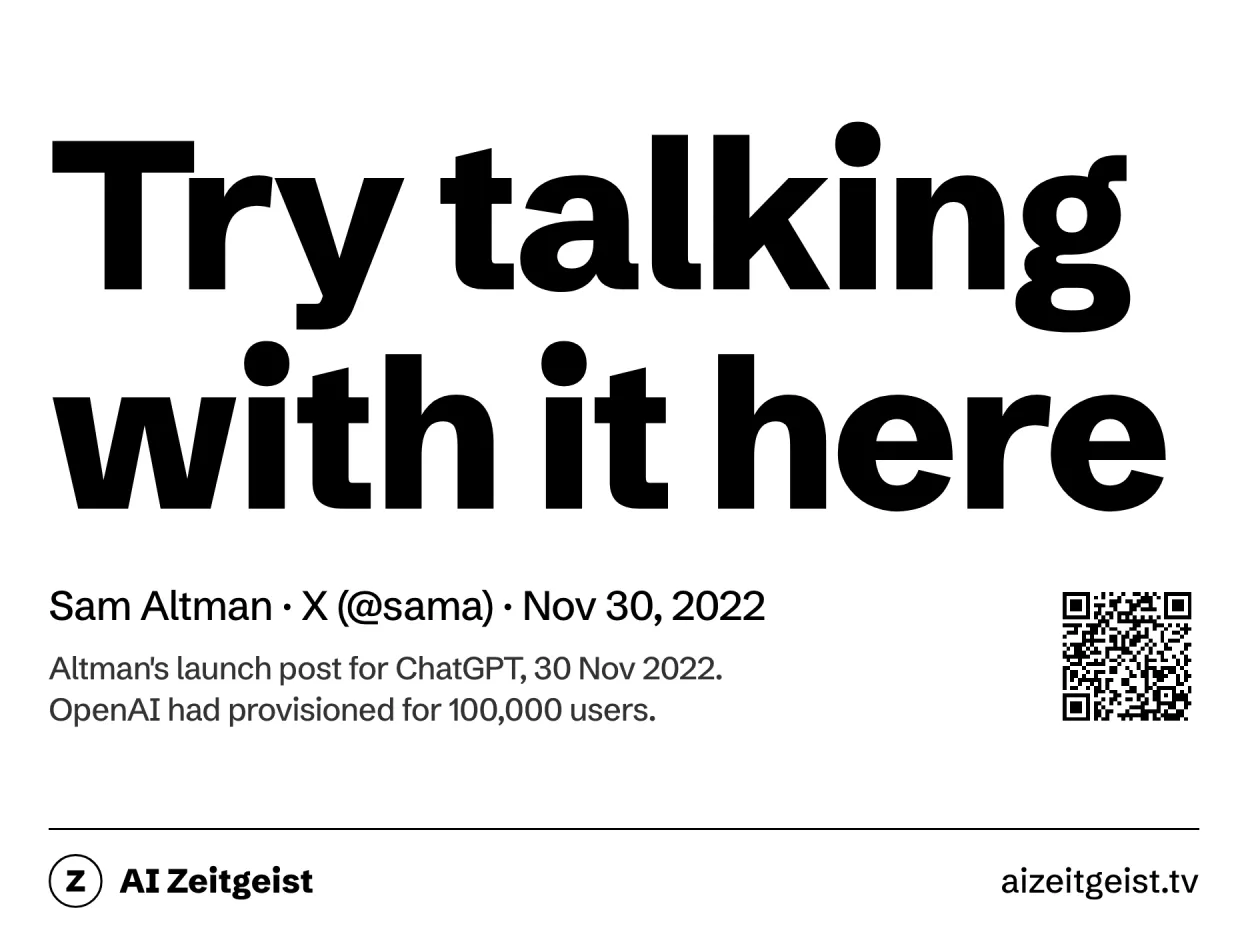
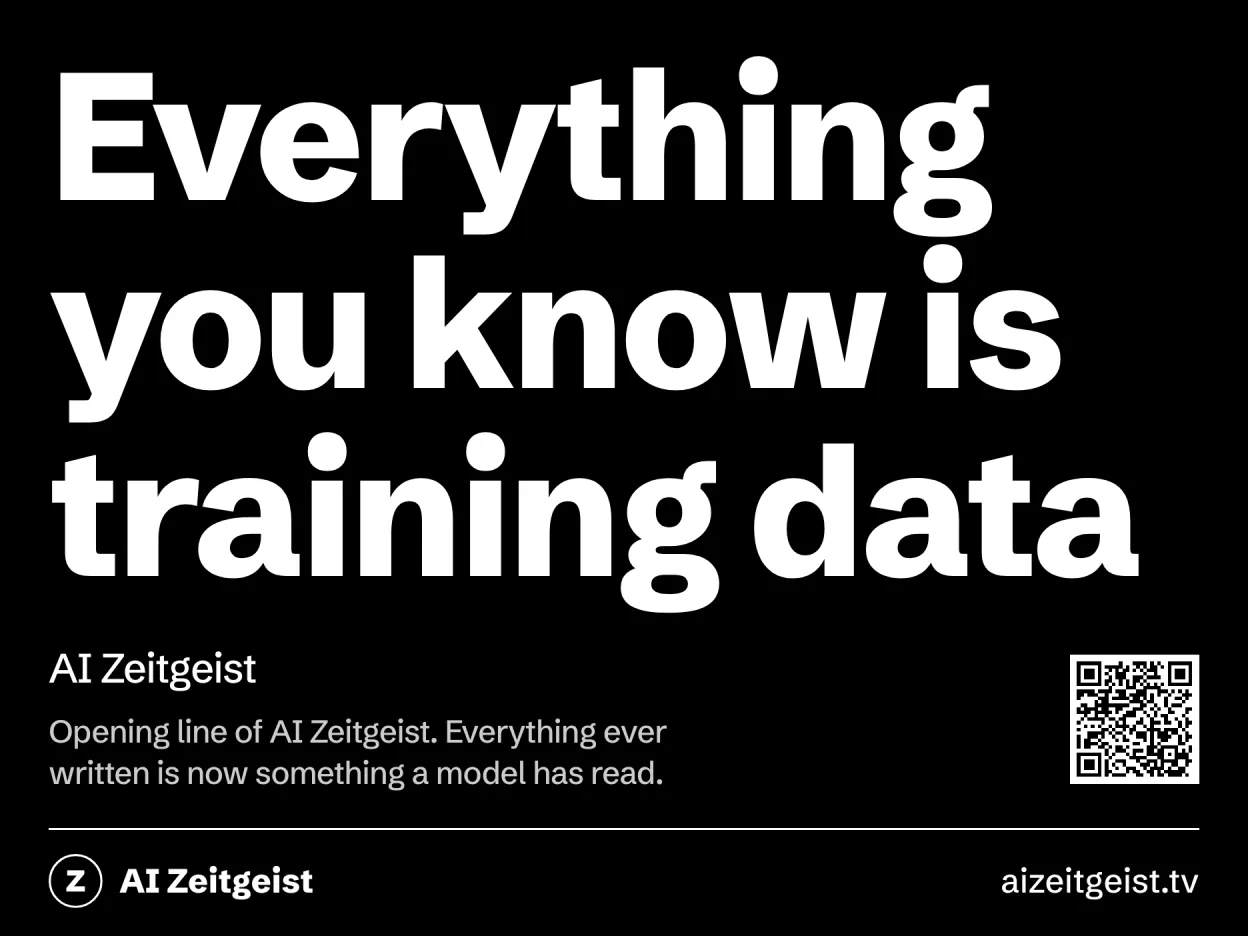
Yes. AI Zeitgeist is a free plugin for TRMNL, the e-ink display for your desk or wall. It shows a new quote every hour, with speaker, source and a QR code to the full quote. Choose light or dark in the plugin settings.
Can I use a quote?
The quotes belong to whoever said them; short quotes with attribution are fine under quotation rules. The wallpaper download and the embed code are for personal use. For anything else, write.
Who runs this?
Büro Bloock, a design studio in Cologne, Germany. AI Zeitgeist is an independent project, not funded by anyone on the wall. Errors, missing sources, a quote that should not be here: hello@aizeitgeist.tv.
Is there press material?
Yes. The press page has a short profile in English and German, key facts, two videos (the launch reel and a how-to reel), logos as SVG, EPS and PNG, and 29 screenshots of the wall, the archive, the speaker, topic and year pages, the mobile view and TRMNL, all in one ZIP. The compilation is open data under CC BY 4.0; the quotes stay with their authors.
Is there an Easter egg?
Yes. We won’t say where, that would spoil it. It is off the record, it takes a little persistence, and so far it has mostly been found by people who click things they probably shouldn’t. If you find it, keep it to yourself. Or don’t: everything on this wall ends up quoted eventually.
Privacy
No ads, no profiles. Fonts are served from this site and your settings live in your browser. Likes are counted anonymously: one number per quote, nothing about you. We use Google Analytics to see which quotes travel, but only if you allow it when we ask on your first visit. You can change that choice any time. See the privacy notice and imprint.
Think big
AI Zeitgeist is an independent project by Büro Bloock, a design studio in Cologne, Germany. We’d love to build a wall like this for your space.
The wall works wherever a big screen meets people. Swap the content, the display and the audience: a gallery, an off-space, a pop-up store, a museum, a lobby, a shop window. Indoors or outside.
The words can come from anywhere: written by hand, aggregated live from news, social streams like Instagram or TikTok, or your own feeds. And the people in front of it join the wall, each one a digital avatar or a name, checked in with a QR code at the door or counted by a camera in the room.


